Trust
“The highest form which civilization can reach is a seamless web of deserved trust. Not much procedure, just totally reliable people correctly trusting one another.”
— Charlie Munger
(I know, I should probably quote someone else for my next post... no promises)
What is trust? How is it created and sustained? Is it as important as I think it is?
Taking an ultra-pragmatic lens, why should anyone trust anyone? What does trust accomplish that careful, self-protective skepticism does not?
My friends might tell you I am a bit obnoxious about the concept of trust… I bring it up often. Too much, maybe.
Trust is a powerful force that permeates nearly every domain, in subtle ways that might not be widely appreciated. Before diving into these questions, I thought it would be helpful to start with a definition. I once came across a formula for trust that I personally find quite useful:
Trust = (Credibility × Reliability × Intimacy) ÷ Self-Orientation
The numerator is reasonably straightforward. Do I believe you are capable? Do I believe you consistently do what you say you will do (high “say-do” ratio)? Am I comfortable being vulnerable and honest with you (psychological safety + genuine personal connection)?
For me, the denominator is particularly interesting, as it’s where things become more nuanced. Self-Orientation is the degree to which someone primarily acts in their own interest… which of course, we are all doing all the time. Even when acting in service of others, we are still fundamentally doing so because we believe it will satisfy some need of our own.
That is no big epiphany… but the relationship between trust and self-orientation is not generally understood. Taking the formula literally… trust is not just reduced by self-orientation… it is divided. Someone can be competent, dependable, even warm, and still not be trusted if every interaction subtly orbits their own agenda.
So how do we pursue our own interests while also building trust with others in a genuine way? This gets particularly insightful when trust is overlaid with incentives. I’ll try my best to avoid sounding too much like an MBB consultant… but I do think a 2x2 framework is helpful here:
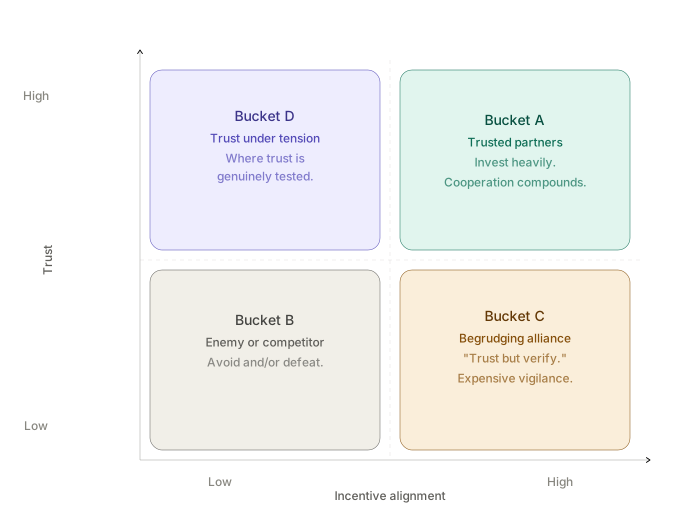
Bucket A: Aligned interests, high trust. The easiest quadrant. We are trusted partners. We want the best for each other and want each other to succeed. Relationships like this ought to be nurtured and protected intentionally. In repeated-game terms, this is where cooperation deepens. The best strategy is to invest heavily. The risk is underappreciating how valuable this quadrant is.
Bucket B: Misaligned interests, low trust. Another easy quadrant. Direct enemy or competitor. Avoid and/or defeat.
Bucket C: Aligned interests, low trust. A type of begrudging alliance akin to “trust but verify,” where constant vigilance is likely wise. This is actually the most common situation in professional life — most business relationships live here. Bucket C is the default mode of contracting, legal agreements, board oversight. It works, but it’s expensive. Every unit of vigilance is a unit of friction and overhead.
Bucket D: Misaligned interests, high trust. This is the quadrant where trust is genuinely tested, because the person you trust has a legitimate, rational reason to act against your interest and you know it. Most frameworks would say this situation should collapse into either renegotiating alignment or withdrawing trust. The “rational” move is to downgrade to Bucket B and treat them as an opponent.
But the “seamless web of deserved trust” describes exactly the opposite impulse: that sufficiently deep trust, built over time through demonstrated low self-orientation, can hold even when incentives diverge. Trust itself becomes the override mechanism. The person could defect and you both know it, but the relationship carries enough weight that they choose not to — not out of contractual obligation, but because the relationship itself has become something they value preserving.
Bucket D is the quadrant that reveals whether trust is real or merely convenient. When interests are aligned, you can never fully distinguish genuine trust from rational cooperation. Bucket D strips away that ambiguity. It’s also where the denominator of the Trust Equation does the most work. Someone with low self-orientation in Bucket D is essentially saying: “I see the misalignment, and I’m choosing the relationship over the narrow optimization.” That is qualitatively different from trustworthiness when it costs nothing.
Bucket D is where trust creates the most value, precisely because it’s where skepticism would be most justified. The counterfactual is enormous: contracts, monitoring, hedging, exit options. When trust holds here, it eliminates all of that friction. That is the Buffett insight — Berkshire runs with almost no internal bureaucracy because the web of trust substitutes for the surveillance apparatus that misaligned incentives would otherwise demand.
These axes are of course not binary, they are gradients.
But there is a dimension missing from this grid that, in retrospect, matters as much as the grid itself.
Do we bear the downside in the same way, or am I the one exposed to irreversible loss?
The Trust Equation tells you whether to extend trust. The 2x2 tells you how trust and incentives interact. But neither answers a more fundamental question: if this goes wrong, who survives? I may believe what someone says, and our incentives may appear to point in the same direction, yet the relationship can still be fundamentally asymmetric. The missing variable is shared exposure to ruin.
Two people can be in the same venture and still not have the same game. One may be a gambler with a portfolio of bets; the other may be the bet itself. One can tolerate losses as part of the distribution. The other cannot survive a bad outcome. A founder and an investor may both honestly want the company to succeed. But if the investor has twenty bets and the founder has one life, that is not true symmetry. “We both want this to work” is not enough.
This matters for the framework. Bucket A (high alignment, high trust) looks like the best quadrant, and usually it is. But if failure is not survivable for both sides, or at least borne symmetrically, even here you still need limits, buffers, and optionality. And in Bucket D — where you trust someone whose interests diverge from yours — this becomes even more critical. You may trust what they say, but if they can diversify the downside and you cannot, their rational behavior may still be dangerous to you. The right move is not just “be careful.” It is to narrow the scope of dependence and protect against irreversible downside.
Luca Dellanna captures this well in Ergodicity: in non-ergodic settings (where the outcome you experience depends on the specific sequence of events, not just their overall population average), averages are not what matter. What matters is whether a bad outcome is survivable for you. The first strategy for managing non-ergodicity is to reduce exposure to game-over (situations like bankruptcy, social ostracism, permanent injury) where no amount of future upside can compensate for the loss. The simplest way is to refuse to participate in any activity with such risk, but of course, to do so would be to miss out on a wealth of opportunity that likely more than offsets it.
Trust is exactly the decision to accept that exposure — to accept uncertainty for a more distant and valuable benefit. But accepting it wisely means understanding who carries the irreversible risk. Shared stake is not the same as shared fate. Real alignment requires more than common upside; it requires either common downside or explicit protections for the party who cannot afford ruin.
The highest-trust relationships are not just ones where people are honest and incentives are aligned. They are ones where the game is structured so that truth, incentives, and survival all point in the same direction.
Okay, I definitely went down a framework rabbit hole. But the point is, trust and incentives matter, and the structure of shared exposure matters even more than we typically acknowledge.
And yet, trust is not created through grand gestures or clever structural design. It is built through small promises kept repeatedly. Do the right thing and do what you say you will, on time, consistently. The frameworks help you understand where trust sits and how it can break. The actual building of it is much simpler (Or maybe harder? I can’t quite decide.)
I was fortunate to grow up in a family where trust was treated as sacred. To this day, my father regularly repeats the phrase my word is my bond. And he means it seriously, not as a catchy slogan. Watching that modeled early gave me something I didn’t fully appreciate until much later: an assumption that trust is the default condition of relationships. That assumption shapes how I move through the world. It also means I notice it immediately — and feel it strongly — when it is missing.
Over time, I’ve come to see trusting relationships as something more than a moral preference — they are intrinsically valuable wherever you can find them. It is not realistic to expect you will only have trusting relationships. But you can choose to seek them out, nurture them intentionally, and organize your life so they occupy more of your time and energy than the alternatives.
Taking the commercial view, trust is a durable and accumulating asset—and that dynamic is only accelerating in a world of widespread AI adoption. We measure revenue, growth, and margins with precision. But the invisible infrastructure that determines whether organizations and relationships genuinely endure is trust. It lowers friction in a way that improves both speed and commitment. Decisions are made faster. Responsibility is assumed rather than assigned. Energy goes toward building instead of protecting.
In low-trust environments, the opposite is true. Meetings get more defensive. Every decision requires more verification. The difference is rarely visible on a spreadsheet. It is unmistakable in lived experience.
And there is an underlying tension that relates back to incentives. I am certainly not the first to point out what seems like the most compelling conclusion of game theory: in a one-shot interaction there is little penalty for opportunism, where you can defect, extract value, and move on. But life is not a series of isolated games. It is a network of repeated interactions with overlapping players. Your reputation often arrives in the room before you do.
Getting the time horizon right is fundamental. I don’t have perfect foresight, so for me that has meant making choices that remain sensible across a range of possible futures. Investing in trusting relationships is one of those choices. You don’t need to know exactly how long a relationship will last to know that behaving in a trustworthy way is robust (and honorable).
Fear, by contrast, is fragile. I believe fear is the opposite of trust.
Back to the denominator of the Trust Equation — selfishness seems to come out of an instinct for self-preservation, “which is our deepest and first instinct” (quoting Anthony de Mello’s unparalleled Awareness).
When living in fear, options narrow and horizons shorten. I’ve noticed this in my own life. When I am operating from fear, I hold things close and over-prepare. The instinct feels prudent, but it is often simply to protect myself emotionally. When I am operating from trust — in myself and in the people around me — momentum emerges. Conversations get to a vulnerable, real place faster. Imperfect ideas get refined collectively. And it is of course way more fun.
There is a quieter side to this that many high-performing people experience but rarely articulate. You spend years building capability. Eventually the world begins to trust you. People defer to your judgment. They make decisions based on what you say. From the outside, this looks like success.
Internally, it can feel different. Trust entangles your outcomes with those of others. You become responsible for those who depend on you, which bears the risk of falling short. Being trusted can feel less like a gift and more like a test you could fail at any moment. Maybe a version of imposter syndrome… but one that is felt even in presence of confidence in one’s capabilities.
One response is hyper-independence. Work alone. Be open only to the degree you can maintain enough distance to feel safe.
Independence is partly strength. It can also become a fortress. I recognize this pattern because I have definitely fallen for it at times.
There is a version of self-trust that is simply arrogance with better branding. I am not talking about that. I mean the kind that requires honest confrontation with my own behaviors and patterns. Performing for approval, waiting until ideas are polished, avoiding exposure until the outcome feels predictable… and choosing to act anyway. Choosing to trust myself before the evidence is complete. Because the evidence is never complete.
Ready is not a feeling. It is a decision.
I can’t find who said this originally, but it deeply resonates with me. I have spent more time than I’d like to admit waiting to feel ready, only to realize that the feeling never arrives on its own. Willingness to act before certainty is a form of trust: trust in your own capacity to figure it out, trust that the people around you will meet you partway, trust that imperfect action beats perfect preparation.
This is where the personal and professional dimensions of trust connect. The fortress of hyper-independence doesn’t just limit your own growth — it limits what you can accomplish with others. Without trust, disagreement becomes personal and accountability becomes threatening. With trust, honest conflict becomes possible. Decisions get made, things get done. It is no coincidence that Patrick Lencioni’s work on organizational health traces everything back to a foundation of trust and willingness to be vulnerable. Much of what we describe as organizational culture is simply the cumulative result of how trust is built, or eroded, over time.
If there is a single rule that captures the spirit of trust, it might be this: Act in ways that make good people glad they trusted you. I have sometimes been asked for advice about how to be a successful professional. My response has always been the same – don’t just “do the job well,” aim to build trust in every single interaction. Do this consistently enough, and something interesting happens. Opportunities begin to flow toward you. Partnerships deepen. People choose to work with you again and again. Not because they must, but because they want to.
I genuinely believe that’s true. Because if you consistently build trust, people will want to rely on you more. As a result, you will get more experience and learn faster, which accelerates into a durable advantage. And of course, having more people who trust you both builds your own confidence and builds a network of people around you who are rooting for you to succeed. Competence certainly matters, but trust determines how quickly competence compounds.
I do not have a definitive conclusion to offer. I am still learning about trust. But a few things have become clearer for me.
Peter Kaufman once described the universal human search this way: your entire life, you are on a quest for that individual you can absolutely and completely trust. Someone who is not just trustworthy, but principled, and courageous, and competent, and kind, and loyal, and understanding, and forgiving, and unselfish. I think he’s right. And I think aspiring to be that person is just as important as the pursuit of finding them.
Trust is not merely a professional advantage or a pleasant trait in relationships. It is the foundation of a meaningful life. The systems we build, the partnerships we form, and the families we sustain all depend on an invisible layer of mutual confidence that cannot be engineered quickly or repaired cheaply. In a world that is becoming faster, noisier, and more mediated by technology, the capacity to be genuinely trusted by other human beings may be one of the few advantages that remains durable.
And maybe that is why I spent so many paragraphs on frameworks. Not because trust is primarily an intellectual exercise, but because understanding where trust lives is what gives me the confidence to extend it wisely rather than withhold it fearfully. The analysis serves the conviction, not the other way around. The point was never to be clever about trust. It was to understand it clearly enough to practice it courageously.
Trust does not eliminate doubt. It makes action possible in the presence of doubt. It means allowing others to rely on my judgment even when I may be wrong. Sharing what I think before it’s polished. Accepting uncertainty.
“Every moment of life presents us with a basic choice: will I respond with fear or with trust?” – Another quote where I can’t remember who said it. Sorry.
Well anyhow, I choose trust. I choose abundance over scarcity, and the long game over the safe one. Not because it always works, not because the downside is imaginary, but because a life organized around trust — around vulnerability, deepening relationships, and the willingness to be wrong in public — is bigger and more meaningful than the alternative.